
The Declaration of Dependence
The Loyalists sent their own letter to London. It did not go well for them
On Saturday, the nation celebrates its 250th anniversary in this Year of the Bicentennial+50. The Continental Congress declared independence on July 2, 1776. Two days later, they debated and edited the Declaration of Independence. On July 8, 1776, Colonel John Nixon publicly read the Declaration aloud in Philadelphia’s State House yard (now Independence Square). This was accompanied by bell ringing (including the Liberty Bell), cheers, and some military displays.
Up to 90% of white men could read—without any teachers unions.
History caricatures John Adams as a prude and a stiff, but he was all for celebrating the anniversary of the declaration every year. In a letter to his wife, he said:
I am apt to believe that it will be celebrated, by succeeding Generations, as the great anniversary Festival. It ought to be commemorated, as the Day of Deliverance by solemn Acts of Devotion to God Almighty.
It ought to be solemnized with Pomp and Parade, with Shews, Games, Sports, Guns, Bells, Bonfires and Illuminations from one End of this Continent to the other from this Time forward forever more.
You will think me transported with Enthusiasm but I am not. I am well aware of the Toil and Blood and Treasure, that it will cost Us to maintain this Declaration, and support and defend these States.
Yet through all the Gloom I can see the Rays of ravishing Light and Glory. I can see that the End is more than worth all the Means. And that Posterity will triumph in that Days Transaction, even altho We should rue it, which I trust in God We shall not.
In a hold-my-beer world we need guys like him who actually hold the beer. He was the uncle who would slip you the hundred dollar bill to buy fireworks. (I wrote about Adams and the 4th in a newsletter 3 years ago.)
But there is another side to the story.
While I have pointed out that the five richest men in America signed the declaration (No. 6 was too busy being General Washington), other men with money did not want independence because they liked being rich Englishmen.
They were men like Lord Frederick Philipse III (1720–1786) who according to the Philipse Manor Hall Historical Society was a fourth generation descendant of Frederick Philipse (1626-1702) who was born 400 years ago as Vrederick Flypsen in Bolswaert, Friesland in 1626. At 21, he headed to New Amsterdam in America. He became the “Official Carpenter” of the Dutch West India Company.
Apparently carpenters back then made a lot of more money because he became quite wealthy. Well, he did more than that.
The Philipse Manor Hall Historical Society noted:
Philipse married the widow Margariet Hardenbroek De Vries 1662. He immediately adopted her two-year-old daughter Maria and renamed her Eva Philipse. The couple had ten children together and amassed a fortune through international trade and real estate. Along with exports of furs and tobacco, Frederick Philipse was one of the first traders to begin exporting wheat. With the establishment of the Manor of Philipsborough by Royal proclamation in 1693, and the introduction of tenant farmers, wheat became the family’s chief export item. Philipse’s ships traveled the world with a variety of items, both luxury and practical, including fine textiles, pots, shoe buckles, paper, spices and enslaved Africans.
Shoe buckles?
He became the wealthiest man in the Dutch colony. Sure, the British took over the town in 1664 and renamed it New York, but he continued to thrive under British rule, so much so that a century later, his great-grandson, Frederick the Third, didn’t have to mind the business. It was 4 generations, not 3. Took me a while to figure out teh Dutch count about as well as they spell.
The historical society noted:
Unlike his predecessors, Frederick Philipse III seemed less interested in politics or trade and focused his attention on developing his Yonkers home, Philipse Manor Hall, and the surrounding landscape into a gentrified country estate worthy of a man of his wealth. He married the widow Elizabeth Williams Rutgers in 1756 and they had nine children.
Well, you can see where all this talk about breaking with England upset Philipse. After all, while he was a Knickerbocker (colonials whose roots were Dutch), he also was a British lord.
Four months after the original Independence Day, a group of men met at the Sign of Queen Charlotte across from city hall. They became Loyalists and drafted and signed a letter to “To the Right Honorable Richard Viscount Howe, of the Kingdom of Ireland, and His Excellency The Honorable William Howe, Esquire, General of His Majesty’s Forces in America, the Kings’ Commissioners for restoring Peace in His Majesty’s Colonies and Plantations in North America &c. &c. &c.”
Well, Governor Gates did bring peace I suppose by surrendering Boston and the rest of New England to the Patriots, who would later draft Tom Brady and win a lot of Super Bowls
More likely the 557 signees (some sources say 547) referred to Gates retreating to New York City and repelling the rebels. This demoralized the continental army. However, Washington crossing the Delaware on Christmas became the nation’s best recruiting ad until Pearl Harbor.
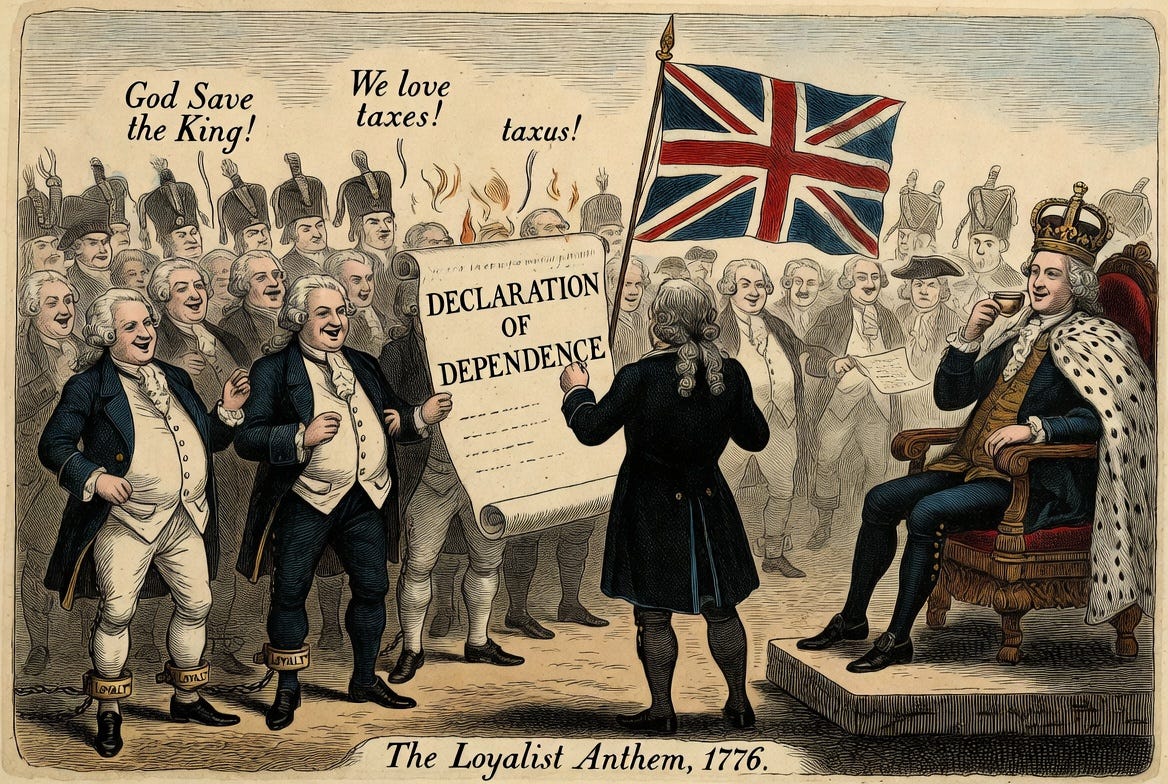
The Declaration of Dependence was about what one would expect—long and sycophantic.
May it please your excellencies.
Impressed with the most grateful sense of the Royal Clemency, manifested In your Proclamation of the 14th. Of July last, whereby His Majesty hath been graciously pleased to declare, “That he is desirous to deliver His American subjects from the calamities of War, and other oppressions, which they now undergo:” and equally affected with sentiments of gratitude for the generous and humane attention to the disposition “to confer with His Majesty’s well affected subjects, upon the means of restoring the public Tranquility, and establishing a permanent union with every Colony as a part of the British Empire.”
We whose names are hereunto subscribed, Inhabitants of the City and County of New-York, beg leave to inform your Excellencies: that altho most of us have subscribed a general Representation with many other of the Inhabitants; yet we wish that our conduct, in maintaining inviolate our loyalty to our Sovereign, against the strong tide of oppression and tyranny, which has almost overwhelmed this Land, may be marked by some line of distinction, which cannot well be drawn from the mode of Representation that has been adopted for the Inhabitants in general.
Influenced by this Principle, and from a regard to our peculiar Situation, we have humbly presumed to trouble your Excellencies with the second application; in which, we flatter ourselves, none participate but those who have ever, with unshaken fidelity, borne true Allegiance to His Majesty, and the most warm and affectionate attachment to his Person and Government. That, notwithstanding the tumult of the times, and the extreme difficulties and losses to which many of us have been exposed, we have always expressed, and do now give this Testimony of our Zeal to preserve and support the Constitutional Supremacy of Great Britain over the Colonies; and do most ardently wish for a speedy restoration of that union between them, which, while it subsisted, proved the unfailing source of their mutual happiness and prosperity.
We cannot help lamenting that the number of Subscribers to this Address is necessarily lessened, by the unhappy circumstance that many of our Fellow-Citizens, who have firmly adhered their loyalty, have been driven from their Habitations, and others sent Prisoners into some of the neighbouring Colonies: and tho’ it would have afforded us the highest satisfaction, could they have been present upon this occasion: yet we conceive it to be the duty we owe to ourselves and our prosperity, whilst this testimony of our Allegiance can be supported by known and recent facts, to declare to your Excellencies; that so far from having given the last countenance or encouragement, to the most unnatural, unprovoked Rebellion, that ever disgraced the annuls of Time; we have on the contrary, steadily and uniformly opposed it, in every stage of its rise and progress, at the risk of our Lives and Fortunes.
In all fairness, they indeed risked their lives and fortunes. Many fled to England to escape retribution. After the war, some were so desperate, they moved to Canada.
But New York City was a safe haven as the British stayed an protected them until November 25, 1783—two years after the surrender of Cornwallis at Yorktown. For many years, the city celebrated Evacuation Day until Thanksgiving overwhelmed the celebration.
And you wonder how Mamdani became mayor? Not a lot of MAGA in the city that never sleeps.
Boston still celebrates its Evacuation Day—March 17, 1776—as a legal holiday. The town keeps the bars open because it is also St. Patrick’s Day.
Yes, one city kicked the British out before Independence Day. The other’s E Day came only after the war ended with the signing of the Treaty of Paris. No wonder New York is run by communists today.
As we celebrate our independence from England, let us also be glad that the Loyalists left and took Benedict Arnold with them.
We are American, without apology.

The Loyalist instinct never really dies. It changes flags. Yesterday it looked to London. Today it looks to Brussels, Davos, Beijing, bureaucracies, courts, universities, and administrative agencies. It distrusts ordinary citizens. It fears self-rule. It prefers credentialed management to republican courage. The American Revolution was not just a break from Britain. It was a break from the psychology of dependence. That is why July Fourth still matters. Bells, bonfires, fireworks, parades, prayer, and unapologetic patriotism are not nostalgia. They are civic memory. We are not subjects. We are Americans — and that still has enemies.
It appears that the loyalists specialized in run on sentences.