
Monroe Crossing the Delaware
The fifth president was shot in the chest and nearly died 40 years before his election
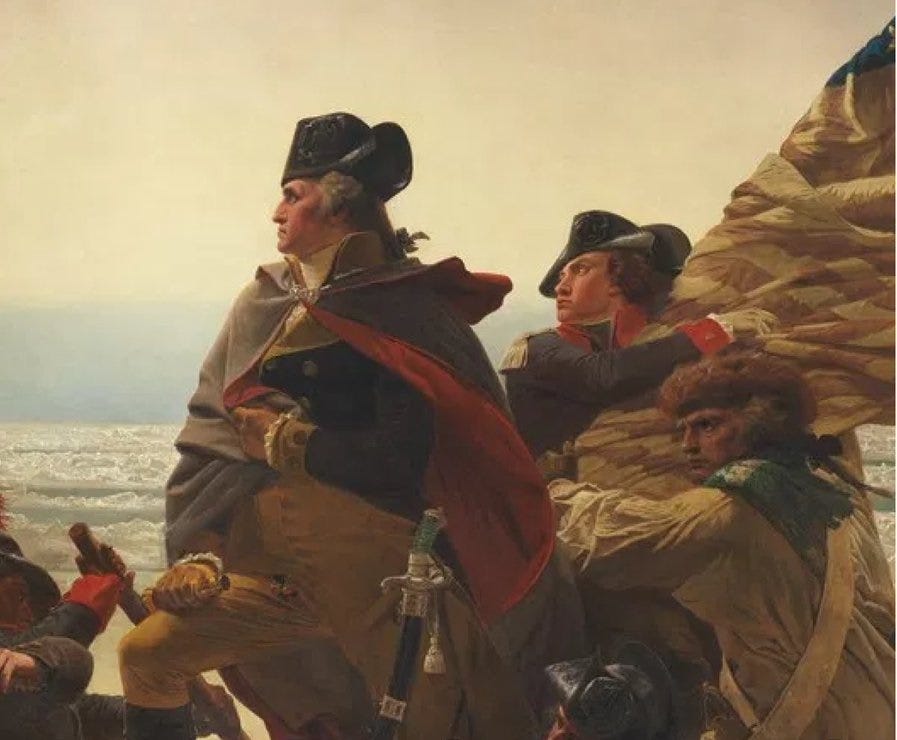
Emanuel Leutze called his 1851 painting Washington Crossing the Delaware, but the masterpiece depicted two future presidents. You see, the man behind Washington is James Monroe, the fifth and final Founding Father to become president. He, too, crossed the river on Christmas Night (not Eve) in 1776.
Oh, Leutze took liberties with history. Scott H. Harris reported:
Leutze’s painting is glorious—and wrong in almost every detail. The river resembles the Rhine more than the Delaware; the boat is too small and of inaccurate design; there is too much light for what was a night crossing; Washington did not cross standing up; the Stars and Stripes had not yet been adopted by the Continental Congress; and James Monroe was not holding the flag, not in the boat, and not even present with the army.
He was already across the river, and he was busy.
Nevertheless, his appearance in the painting was a nod to the breadth of Founding Fathers. Washington was 44 at the time—old enough to be 18-year-old Monroe’s father. The inclusion of Monroe also showed Leutze knew American history better than most Americans.
Monroe’s young age belied his maturity. In 1772, his parents died and he had to leave the College of William and Mary to take over the farm and take care of his siblings. He inherited a pile of bills that his Uncle Joseph Jones assumed.
His childless Uncle Joe took him under his wing, introducing him to Thomas Jefferson, Patrick Henry, and George Washington. Monroe already had met and befriended John Marshall at college. Virginians were thicker than an encyclopedia.
Lawrence Washington, George’s older half-brother, also had no children and took him under his wing when their father died. Likewise John Hancock worked for and inherited his childless uncle’s successful mercantile business. Death was more common then, it seemed, and families looked out for their brothers and nephews.
Early in 1776, Monroe enlisted in the 3rd Virginia Regiment in the Continental Army under Captain William Washington, a second cousin of the first president. The enlistment came days after Monroe’s brother Spence died. Settling America in the 18th century was not for the faint of heart.
Duty called and Monroe answered. Commissioned as a lieutenant, he and 700 other Virginia infantrymen headed north to fight in New York and New Jersey. Battling the fiercest military on Earth at the time was not easy. Declaring independence was easy. Fighting for independence was far harder, especially as a smallpox epidemic. It killed 1 in 3 of those infected. Washington was among those infected.
On December 7, the Continentals retreated across the Delaware. Morale was low, sickness was high and enlistments were ending. To rally his troops, Washington had them read a new column by Thomas Paine, which included these words:
These are the times that try men’s souls; the summer soldier and the sunshine patriot will, in this crisis, shrink from the service of his country; but he that stands it now, deserves the love and thanks of man and woman. Tyranny, like hell, is not easily conquered; yet we have this consolation with us, that the harder the conflict, the more glorious the triumph.
Washington needed to do something daring and that something was to attack the Hessian garrison at Trenton, New Jersey. He chose Saint Stephen’s Day—the day after Christmas—as his D-Day.
Saint Stephen was the first Christian martyr after the crucifixion of Jesus. The Sanhedrin stoned him to death on December 26, 36 AD, for blasphemy. Over the millennial, the day has become Boxing Day in which gifts are given to the poor.
Washington’s plan was to send three armies from three directions to take Trenton.
The weather did not cooperate and the snow and ice had only Washington’s army arrive for the battle.
The 3rd Virginia Regiment sent 50 soldiers, including Lt. Monroe, to secure the route to Trenton. Decades later, Monroe wrote in his autobiography:
The command of the vanguard, consisting of 50 men, was given to Captain William Washington, of the Third Virginia Regiment . . . Lieutenant Monroe promptly offered his services to act as a subaltern under him, which was promptly accepted. On the 25th of December, 1776, they passed the Delaware in front of the army, in the dusk of the evening, at [McKonkey’s] ferry, 10 miles above Trenton, and hastened to a point, about one and one-half miles from it, at which the road by which they descended intersected that which led from Trenton to Princeton, for the purpose, in obedience of orders, of cutting off all communication between them and from the country to Trenton.
The tempestuous weather, as Monroe put it, was not the biggest problem.
Lurking within Washington’s headquarters was a British spy who has never been identified. This spy was privy to the early deliberations of Washington’s war council and correctly passed along to British Major General James Grant that Washington’s army was looking to attack north of the river. Grant passed along this information to General Leslie and Col. Von Donop who then passed it along to Col. Johann Rall at Trenton. And while Grant stated that he did not think Washington would attack, he did command Rall to be vigilant. Rall acknowledged receipt of this important intelligence at about the same time that Washington was beginning his crossing. With typical Hessian bravado, Rall dismissed or even welcomed the threat stating “Let them come… Why defenses? We will go at them with the bayonet.”
The day before, Rall had received two American deserters who had crossed the river and told the Hessians that the American army was ready to move. Other loyalists informed the Hessians that an attack was imminent. So why wasn’t Rall more active in opposing the crossing or better prepared to defend the town? History records that a series of false alarms and the growing storm had given the Hessian defenders a sense that no attack was likely this night. How might history have changed if the Hessians responded differently to all this intelligence?
History might have us sipping tea and calling cookies “biscuits.”
The march to Trenton was treacherous and they fell behind schedule. Arriving at 8 AM, the Continental Army still caught the Hessians off guard and the battle was a rout. Two Americans died from exposure and 5 were wounded, including Monroe.
The Americans killed 22 Hessians, wounded 53, and captured 800, more POWs than they could handle. Washington declared victory and took his army back across the Delaware that afternoon.
Except Monroe.
His autobiography (he referred to himself in the third person) noted:
Captain Washington then moved forward with the vanguard in front, attacked the enemy’s picket, shot down the commanding officer, and drove it before him. A general alarm then took place among the troops in town. The drums were beat to arms, and two cannon were placed in the main street to bear on the head of our column as it entered. Captain Washington rushed forward, attacked, and put the troops around the cannon to flight, and took possession of them. Moving on afterwards, he received a severe wound and was taken from the field. The command then devolved upon Lieutenant Monroe, who attacked in like manner at the head of the corps, and was shot down by a musket ball which passed through his breast and shoulder. He was also carried from the field.
Mountain Man Medical paid tribute to the man who saved Monroe, Dr. John Riker. Their first meeting was confrontational as his hounds woke him in the middle of the night. He went to investigate.
At first thinking they were British troops, he at once became belligerent and voiced his many unhappy opinions of the British empire. President Monroe later recalled in his memoirs about meeting Dr. Riker:
“He was very violent and determined in his manner, and very profane and wanted to know what we were doing there on such a stormy night.”
After a time of enduring the harassment from the good Doctor, Monroe had enough and threatened to arrest the man if he didn’t go away. Soon after, Dr. Riker realized his mistake and changed his tune dramatically.
Seeing now that they were not the enemy, support poured out from the farmer, and he invited them all into his home to feed them breakfast before the coming battle.
Hours later, Riker saved Monroe’s life. MMM reported, “The bullet severed an artery, and he began to bleed profusely and would have died if he had not been swiftly transported to the Doctor who was already seeing to the care of the Captain.
“Dr. Riker was able to clamp the artery and control the bleeding in Monroe’s shoulder and save his life.”
The Lord spared Monroe because He had bigger plans for him.
They never removed the bullet, but he lived another 55 years, meeting his maker on July 4, 1831. Along the way, he helped Jefferson negotiate the Louisiana Purchase, got Florida from Spain and imposed the Monroe Doctrine which kept us out of European wars for nearly a century. President Trump has brought it back.
He also was the only president besides Washington to be unopposed in his re-election. The Electoral College gave one of Monroe’s votes to his Secretary of State (and successor) John Quincy Adams so that Washington alone would be the only president elected unanimously.
Thank you, Dr. Riker.

Thank you, Don, for sharing your wonderful writing. Merry Christmas
The United States of America “One Nation Under God indivisible, with liberty and justice for all!” Let us all pray that the sacrifices of our founding Fathers and the millions who also fought and died for this magnificent country did not do so in vane.