
ESPN created this monster
TV money and legalized gambling ruined college sports
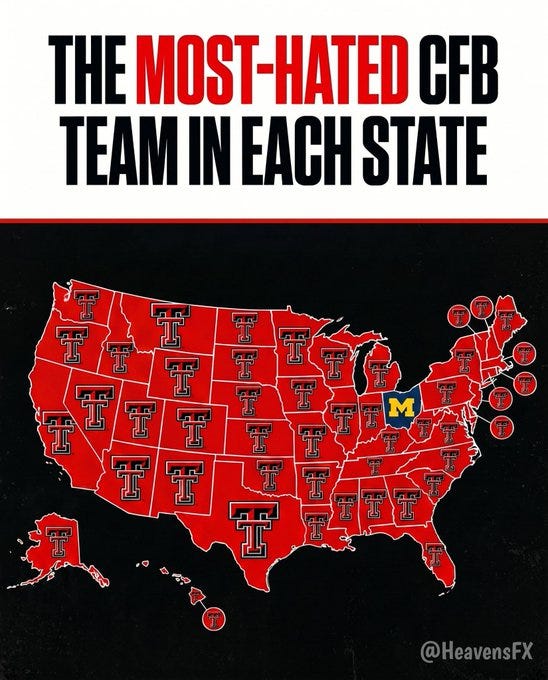
Ya got trouble right here in college football. Trouble with a Capital T that rhymes with B and stands for Brendan Sorsby.
Or so the NCAA would have you believe.
Sorsby is a vagabond college football quarterback who just signed to play for Texas Tech, his third team. The school will pay him $5 million.
But Sorsby bet $90,000 on college football games, which of course is against the NCAA rules. The team sought an injunction in its home county (Lubbock) against enforcing the rule. The local judge recused himself and Tarrant County Judge Ken Curry popped out of retirement to grant the injunction until the case is argued after the season ends.
Let the virtue signaling begin!
Trey Wallace of OutKick wrote, “The integrity of college athletics has officially left the building, and the final nail in the coffin came from a Houston judge who ruled that Texas Tech quarterback Brendan Sorsby can play this upcoming season for the Red Raiders after admitting to gambling on his own team.
“What Judge Ken Curry just essentially said was that you can break the rules, but because you will suffer monetary gains from an ineligible ruling from the NCAA, we’re going to paint the ones who enforced the rules as the bad guy.”
Integrity!
Yahoo’s Dan Wolken wrote, “The entire crisis around Brendan Sorsby could be avoided with one simple decision. Texas Tech could choose to do the right thing and tell its starting quarterback his services are no longer needed. Why is it too much to ask the adults at Texas Tech—starting with mega-booster Cody Campbell and his underlings to just suck it up and do the right thing here?”
Do the right thing!
Chris Fowler, ESPN’s lead college football play-by-play voice, said, “College football is filled with upsets. The fact that a Lubbock judge ruled that way I would not call an upset.
“I think you can find a judge to an injunction for or against anything in the world and it didn’t surprise me gambling is a pretty serious thing it should be taken really seriously by anybody who’s in charge as you said the problem is no one is in charge of college football so maybe there’s other chapters to happen.
“I mean I never take pleasure in seeing a dude make a big mistake and then have it cost in his career but there are consequences for these things.”
Consequences!
I agree that college football has no integrity because it (and the U.S. Supreme Court) failed to do the right thing and now thhe game suffers the consequences.
Once upon a time, the NCAA tried to stop the madness.
But on June 27, 1984, in NCAA v. the University of Oklahoma, the Supreme Court ruled 7-2 that colleges could sell TV rights directly without the NCAA’s permission citing antitrust laws.
One of the biggest impediments to progress is the Sherman Antitrust Act of 1890. It is so ridiculous that in 1945, the feds used it to bust Alcoa even though it had no competitors having invented the modern electrolytic process for making aluminum from bauxite.
Judge Learned Hand acknowledged that Alcoa had not engaged in classic predatory or exclusionary tactics but still found Alcoa guilty of illegal monopolization because it expanded capacity aggressively to meet growing demand, keeping prices low enough to discourage new entrants.
Got that?
Alcoa kept prices low, just like Rockefeller did with Standard Oil, helping consumers. This stupid antitrust law and overzealous attorney general punished the companies for being successful.
The reason Alcoa expanded was the need for aluminum to make the planes that won World War II. Had it raised prices, the government would have accused Alcoa of war profiteering.
The judge stayed the ruling until the government’s need for aluminum abated. Learned Hand? How about Hypocritical Bigfoot?
In NCAA vs. Oklahoma, the antitrust law opened a Pandora’s Box of woes. Television outlets chased college football rights like children scrambling for Easter eggs. College football no longer was an amateur game. The sport became a rainmaker that did not have to pay its players.
Today, college football is a hurricanemaker. ESPN alone pays $5 billion a year to broadcast the games.
TV rights pay each Big Ten team $80 million a year, SEC teams get $72 million a year, Atlantic Coast Conference (ACC) teams get $47 million a year, and Big 12 teams like Texas Tech get $40 million a year while others in the conference get $31 million a year.
Television changed the leagues. The Big Ten has 18 teams as does the Big 12. The ACC has extended the Atlantic to California as it expanded to 16 teams.
With all the money coming in, the NCAA added more games for TV. In 1979 when ESPN began, there were 15 bowl games. Today there are 47 including the college football playoffs.
In 1979, Alabama went 12-0 to win the national title. Today, that record would cover only your regular season. Indiana had to go 16-0 to claim the title last season.
College football became a racket. The networks made money. The coaches made money. The college athletic departments made money and used it to subsidize women’s and other non-revenue sports.
The only people who didn’t make money were the football players—45% of whom are black—you know, the people who risk CTE and bad knees in middle age.
The argument to keep football amateur for the players was well, you get $50,000 a year scholarships. Coach gets millions. You get to attend class and live on campus to attend classes in addition to your full-time job as a football player.
Football stopped being a fall season only long ago—at least at the big schools.
But ESPN and the rest don’t buy TV rights out of the kindness of their hearts. Cable license fees and commercials pay for those rights. ESPN now averages a cable fee of $9.42 per month for each customer regardless if they watch the channel.
The commercials are dominated by an industry that most benefits from college football.
Gambling.
Bookies take between $8 billion and $15 billion in college football bets each year. About 10% goes to the house.
States meanwhile pocket roughly $3.7 billion a year from the bookies for all sports.
Sorsby’s first school was Indiana in a state that collects 9.25% of the house’s money.
His next school was Cincinnati where Ohio takes 20% of the house’s money.
The most famous line from the anti-drug commercials in the 1980s was “This is your brain. This is your brain on drugs. Any questions?”
The runner-up lines applies here: “Where did you get it? Answer me! Who taught you to do this stuff?”
“You, ALRIGHT! I learned it by watching you!”
I am not excusing Mister Sorsby or Texas Tech. He should not be on the team. Period.
However, let us remember how and why we got here. We got trouble with a capital T, which stands for television.
I opened today’s letter with a parody of Ya Got Trouble from The Music Man, a loving tribute to small town America and hustlers circa 1912. The trouble then was gambling. It still is today. There were very good reasons we banned gambling. There was no good reason to legalize it.
To raise money for schools? Ha! That is what they said about sales taxes and income taxes. The government would let you pimp your mother as long as you kick back 20% in a tax to raise money for schools.

Gambling hasn’t ruined just college sports, it has filtered down into high school. Greed. Simple greed. It destroys everything it touches.
It has destroyed our social fabric. Everyone wants more more MORE!! No one seems to be satisfied with a simple life anymore, except old farts like me. I just want to wake up in the morning, drink my coffee, read my “Surber” and get on with my day working for the company who has been part of my family for 30 years.
I just want to keep my family fed and healthy.
May GOD Almighty continue to bless and protect President Donald J. Trump and these United States of America.
APS
I’m blowing the whistle on the poll. I don’t hate Texas Tech or any other school. This is what’s call a first world problem, and a minor one at that. I only have so much disgust to spread around and this ain’t on my radar. I woke up feeling like the aching jointed old man that I am. My 1st concern is coffee.